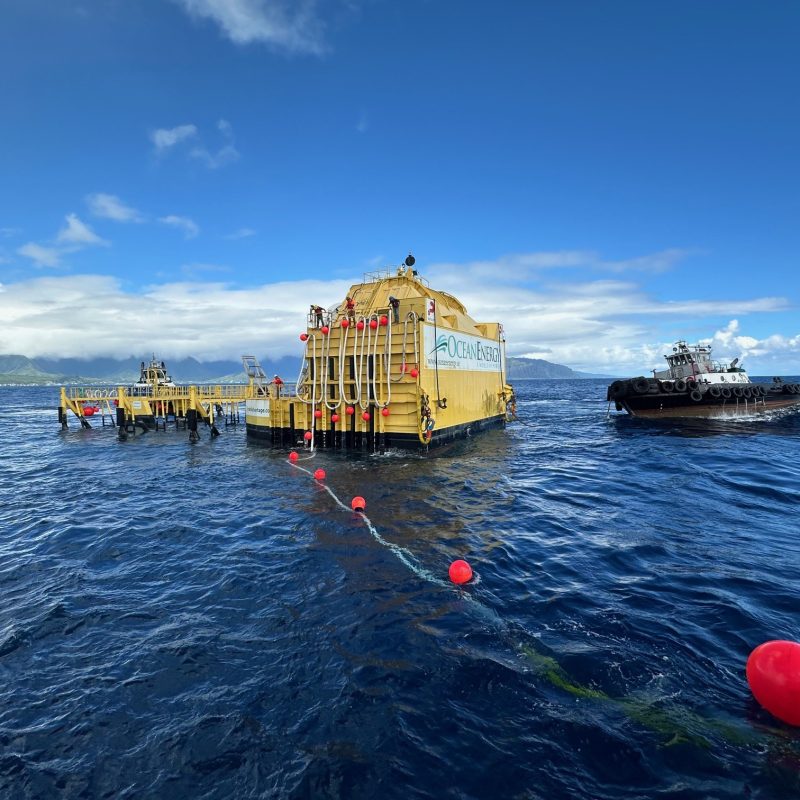
The WEDUSEA project has procured the synthetic fibre ropes that will be used to secure our wave energy device when it is deployed for testing at EMEC.
Every single last element of the WEDUSEA project represents a state of the art development, at the forefront of innovation in the sector. Our choice of fibre rope was not a simple one, it is informed by many years of academic research.
The procurement process has been led by University of Plymouth, one of the partners in our pioneering collaborative project. Professor Lars Johanning of University of Plymouth is a world renowned expert in mooring designs for renewable energy, having published scores of academic papers on the subject.
At the WEDUSEA project, we are pleased to benefit from his extensive expertise.
The importance of the mooring system
Professor Lars Johanning explains:
“The choice of mooring system is critical as it directly affects installation, energy take-off and long term reliability and hence has a significant influence on costs.
This is an area where other marine industries, notably oil and gas, have extensive experience but the high energy regions in which marine renewable energy devices are deployed pose particular installation difficulties and operating conditions.
In the offshore oil and gas industry, synthetic fibre ropes have been in service as mooring lines for floating offshore platforms for more than 15 years. This has provided a wealth of experience with regards to design, qualification, installation and behaviour. In general, however, these have been chosen for deep water moorings beyond 1000 metres depth, whereas the majority of marine renewable energy devices currently being considered are in tens of metres depth, close to the coast, so the loadings are quite different. This means that relying on existing offshore standards could potentially result in overengineered and expensive mooring system designs for marine renewable energy.
Recently, there has been a movement towards replacing heavy steel chains with synthetic fibre ropes for tethering wave energy installations (as well as other marine energy projects such as tidal energy.)
The main arguments for synthetic fibre ropes are the possibility to adapt the mooring to the large movements of floating devices, using rope compliance to reduce peak loads while minimising energy loss, and reduced cost.”
The advantages of synthetic fibre ropes
Constructed from materials like nylon, polyester, and HMPE (High Modulus Polyethelene), they offer high strength, corrosion resistance, and tunable elasticity, making them useful for surviving harsh ocean conditions and maximizing power capture.
Here are some of the reasons that synthetic fibre ropes are ideal for tethering wave energy devices.
- Tuning and Damping: Wave energy devices are highly responsive and rely on dynamic motion to generate electricity. Synthetic ropes possess specific axial stiffness and damping properties that can be engineered to match a device’s natural resonance, effectively tuning the wave energy converter to harvest more energy.
- Compliance and Load Reduction: Unlike rigid steel chains, synthetics can stretch, absorbing harsh, highly dynamic wave loads and preventing sudden snap loads.
- Weight and Ease of Handling: Because their density is close to seawater, these ropes eliminate the need for heavy anchor lines. This eases offshore installation and maintenance operations.
- Corrosion Resistance: Long term durability is a critical focus as these ropes are subjected to continuous cyclic loading, abrasion from seabed contact or the WEC hull, and potential UV exposure on the surface
There remain challenges in picking exactly the configuration of fibre rope to be used for a particular project.
There are a number of different synthetic fibres used for rope making, as well as different methods for construction, so all of this needs to be examined and tested in detail.
The large range of fibre and rope constructions available offers extensive possibilities for tailoring the mooring to the response of the device and maximising energy recovery.
Overall, following our extensive research, we have selected an innovative mooring solution for WEDUSEA.
The mooring solution for WEDUSEA
We have selected a nylon rope, which has been chosen for its lightweight and strong properties, as well as its elasticity, which helps absorb dynamic loads caused by wave. Midway through the mooring line, a buoyancy support is attached. This buoyant component provides an upward force, helping to keep the mooring line floating and reducing the load on the lower sections of the system.
Following the nylon rope is a Dyneema pigtail, made from a high-strength synthetic fibre. (Dyneema is the brand name for Ultra-High-Molecular-Weight Polyethylene. It is a gel-spun synthetic fibre celebrated as the “world’s strongest fibre.” Weight-for-weight, it is up to 15 times stronger than steel and floats on water.) The Dyneema pigtail serves as a flexible, strong, and lightweight connection between the nylon rope and the polyester hawser.
The polyester hawser, a robust synthetic rope, is utilized in the upper portion of the mooring line, ensuring a secure connection between the Dyneema pigtail and the wave energy device. In future sea trials, the mooring system will be configured first, followed by the towing ship positioning the WEDUSEA wave energy device at the designated location and finally connecting the polyester hawser and Dyneema pigtail. This design facilitates easy deployment of the wave energy prototype due to the lightweight nature of the Dyneema pigtail and polyester hawser.
We believe that this choice of mooring solution, utilising synthetic fibres ropes, offers the best option for reliable, cost-effective mooring for our WEDUSEA wave energy device.
On behalf of WEDUSEA, University of Plymouth have undertaken a thorough procurement exercise before awarding the contract and we are looking forward to taking delivery of the synthetic fibre ropes that will be a vital component of the project’s success.
You can read a research article by Professor Lars Johanning and colleagues here – an overview of synthetic fibre moorings for marine renewable energy.
You can also find out more in a publication on the WEDUSEA website – advancements in mooring systems for OE35.
https://wedusea.eu/publications/


