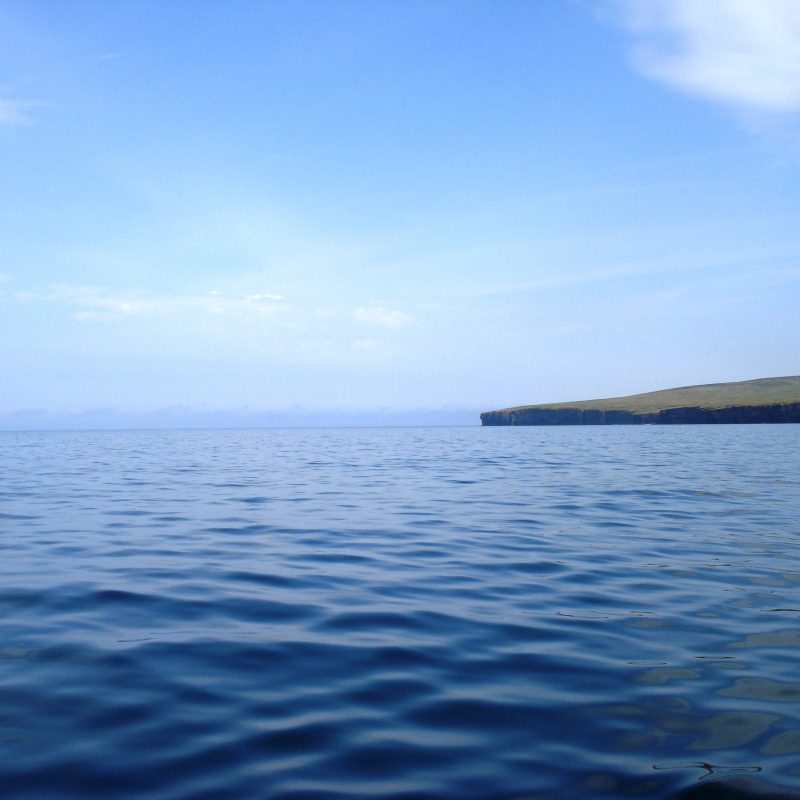
Billia Croo in Orkney is one of two grid connected marine energy test sites owned and operated by European Marine Energy Centre (EMEC). EMEC is recognised globally as a leader in marine energy testing, having supported hundreds of deployments.
Billia Croo will see deployment of the innovative wave energy device being tested by the WEDUSEA project.
Billia Croo will play a pivotal role in our journey to the commercialisation of wave energy, and we would like to share with you some of the exciting features of this world class wave energy test site.
Location of Billia Croo
Billia Croo is located approximately five miles west of Stromness on Orkney in Scotland. Constructed in 2003, the site faces the full force of the North Atlantic, where powerful swells and consistently high wave energy levels provide an ideal natural laboratory for testing marine energy devices.
This is an area with one of the highest wave energy potentials in Europe. Waves here can reach significant heights, with annual average wave heights around 2–3 metres and storm waves exceeding 15 metres. The highest wave recorded by EMEC so far was 18 metres!
Billia Croo thus offers real-world conditions that are invaluable for technology developers such as WEDUSEA who are seeking to prove their systems’ durability and performance.
Infrastructure and Facilities
The test site at Billia Croo is equipped with five cabled test berths, each connected to the onshore substation via subsea power cables. This infrastructure allows developers to feed electricity generated by their devices directly into the national grid, providing real-time performance data and demonstrating grid compatibility.
The five test berths are sited in water up to 70m in depth (four at 50m, one deeper), located approximately 2km offshore and 0.5km apart. In addition, a near shore berth is situated closer to the substation for shallow water projects.
The five 11kv subsea cables feed into the EMEC onshore substation which houses the main switchgear, backup generator and communications room. This is where the cables feed the electricity generated by the wave energy converters testing on site directly into the national grid. The substation has been designed to minimise visual impact on the rocky beach, whilst housing complex electrical systems and data acquisition equipment, collecting detailed information on wave energy device performance, grid interaction, and environmental conditions.
EMEC also provides a suite of environmental monitoring tools, such as wave buoys, acoustic sensors, and video cameras, ensuring that both technological and ecological impacts are thoroughly assessed.
Three waverider buoys are located on site measuring the wave height, period and direction, and a purpose-built weather station provides real-time met data. This data is fed into a sophisticated SCADA (Supervisory, Control and Data Acquisition) system, with live data feeds on the wave and met conditions available to view on the EMEC website.
The test site berths are monitored by CCTV situated at EMEC’s observations point at the Black Craig – a former coastguard lookout station which has been converted to house powerful cameras for monitoring the activity out at sea. This is controlled remotely from EMEC’s data centre and office facilities.
Environmental Considerations and Monitoring
Operating in a sensitive marine environment, Billia Croo places a strong emphasis on environmental stewardship. EMEC works closely with stakeholders, including local communities, conservation groups, and regulatory bodies, to monitor and minimise ecological impacts.
The marine region has typical plankton diversity for northern British coastal waters and local fish species are also present. With regard to ornithological importance, there are no internationally or nationally significant species residing here. Minke whale and Risso’s dolphin have been sighted, and records further offshore indicate that white sided dolphin, killer whale, and pilot whale use the area for passage, although there are no known resident populations of cetaceans in the area.
The area is used for vessel passage, with the adjacent sea used by trawlers passing through on the way to fishing grounds. Inshore fishing takes place around the test area targeting lobster and crab species. The wave test site is located within a charted area to be avoided by vessels larger than 5,000grt.
Comprehensive monitoring programmes track marine life, seabird activity, noise levels, and seabed conditions. Data collected helps inform best practice guidance for future developments, ensuring that wave energy technologies can be deployed responsibly and with minimal disruption to the ecosystem.
Economic and Community Impact
The presence of EMEC and the Billia Croo site has brought tangible economic benefits to Orkney. The facility has created skilled jobs in engineering, science, and support services, and has fostered a vibrant local supply chain. Orcadian companies provide marine operations, fabrication, logistics, and environmental consultancy, helping to embed the industry within the community.
Beyond the economic impact, the site has positioned Orkney as a global centre of excellence for marine energy. The region regularly hosts delegations, conferences, and study tours, showcasing its expertise and attracting further investment. The legacy of Billia Croo extends far beyond Orkney’s shores, inspiring coastal communities worldwide to explore their own renewable energy potential.
The Future of Wave Energy
The advances achieved at Billia Croo demonstrate the power of collaboration between industry, academia, and government. As technology matures and costs fall, the lessons learned at Billia Croo will help pave the way for the deployment of wave energy farms around the globe. EMEC’s ongoing commitment to innovation ensures that Billia Croo will remain at the forefront of marine energy for years to come and we are proud that WEDUSEA is set to be one of its landmark projects.
Find out more about EMEC and Billia Croo at https://www.emec.org.uk


