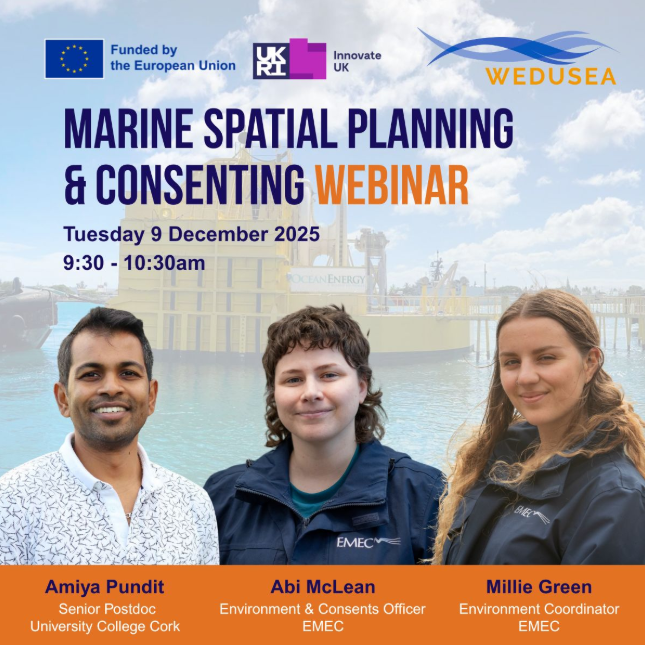
On 9th December 2025, over thirty delegates joined the WEDUSEA team for an online webinar about Marine Spatial Planning and Consenting. The webinar brought together experts from across the WEDUSEA partnership, sharing the project’s journey through the Planning and Consenting stage and discussing wider policy frameworks influencing the future of offshore renewables.
Speakers included: Amiya Pundit, (Senior Postdoctoral Researcher, University College Cork,) Abi McLean, (Environment & Consents Officer, EMEC,) and Millie Green, (Environment Coordinator, EMEC.)
What is Marine Spatial Planning?
Marine Spatial Planning (MSP) is a public process to manage human activities in the ocean, creating plans that balance economic development (eg shipping, renewable energy, fishing, tourism) with environmental protection (conservation, ecosystem health) to achieve sustainable, efficient, and coherent use of marine space, reducing conflicts and fostering synergies between different sectors and goals. In essence, MSP provides a framework for making informed, coordinated decisions about our oceans, ensuring they remain productive and healthy for future generations.
Offshore renewables need to obtain state consent for construction and operation. This consent will not be granted if its plan contravenes or violates environmental regulation including those on the protection and conservation of marine species and habitat. The consenting process is a critical and often complex phase of offshore renewable project development, regarded as one of the biggest barriers.
It is against this background that the WEDUSEA partnership set out to share its own insights.
Summary of the WEDUSEA webinar on MSP and Consenting
After a short introduction to WEDUSEA by Professor Lars Johanning, (Chair of Ocean Technology at University of Plymouth,) Amiya Pundit (UCC) kicked off the webinar with a presentation on “Comparison of policy frameworks for the development of offshore renewables and the need for design flexibility.”
Amiya explained the key learnings so far from renewable energy developments, including offshore wind. He highlighted the EU’s Maritime Spatial Planning Directive, introduced in September 2014, that has so far been adopted by 70 countries. He showed how zones are used to minimise conflict across different sectors of activity; detailed the main barriers to development; explained how some countries have a centralised approach to MSP, while others have a de-centralised hybrid model; and shared case studies from ten countries detailing their consenting process and the licenses required.
Amiya stressed the crucial need for design flexibility, as the MSP policy is at different stages of development in different countries.
Abi McLean (EMEC) then presented “An overarching view of the consenting and licensing requirements for the WEDUSEA project at Billia Croo.”
Billia Croo is EMEC’s grid-connected wave energy test site in Orkney, the test site to be used by WEDUSEA in its demonstration project, which is set to deploy in Summer 2026. Various consenting processes are implemented across EMEC’s test sites which are required by Marine Directorate – the regulator acting on behalf of Scottish Ministers – in order to install, operate, and decommission infrastructure within the marine environment.
Abi explained the vital role of licensing; the different types of consent needed in Scotland as well as providing an overview of the key regulator, and consultees that may be involved in an application. She then explained how the consenting process works and how the project envelope is used to streamline the process; the supporting documentation that is needed, including the project information summary; assessing environmental impacts and navigational risks; factoring in decommissioning; using third party verification; and the typical timescales and costs involved in applying for consent.
Finally, Millie Green (EMEC) presented on “Environmental considerations from EMEC’s experience in managing these processes.”
Millie explained that, being a new technology, there are uncertainties about how wave energy devices will interact with different marine species. Robust data is needed for development of the project and to reassure regulators and stakeholders. There is also the added challenge of monitoring in harsh environments. The scope of work will cover acoustics, biophysical interactions with marine life, seabird interactions and the impact of altering the wave energy flow. A large volume of data will generate a series of reports and compare the findings with metocean data; this work will play a vital role in supporting consents and licensing.
The WEDUSEA partnership is proud to be operating at the forefront of MSP for wave energy, helping shape a sustainable future.
You can watch the whole webinar here. https://www.youtube.com/watch?v=mxDtPH13w8o


